

 7026275757
 Chat with us
Synopsis
Table of Contents
Introduction
The role of communication is unparalleled in all walks of life, especially during the developmental years, when a child asks for help, shares excitement, builds relationships, and makes sense of the world around them. While every child communicates differently, for autistic children, interactions often include challenges. Being on the spectrum affects their behaviour and speech patterns. Speech therapy for autism offers the support needed to navigate such communication challenges and supports overall development and independence.
What is Speech Therapy For Autism?
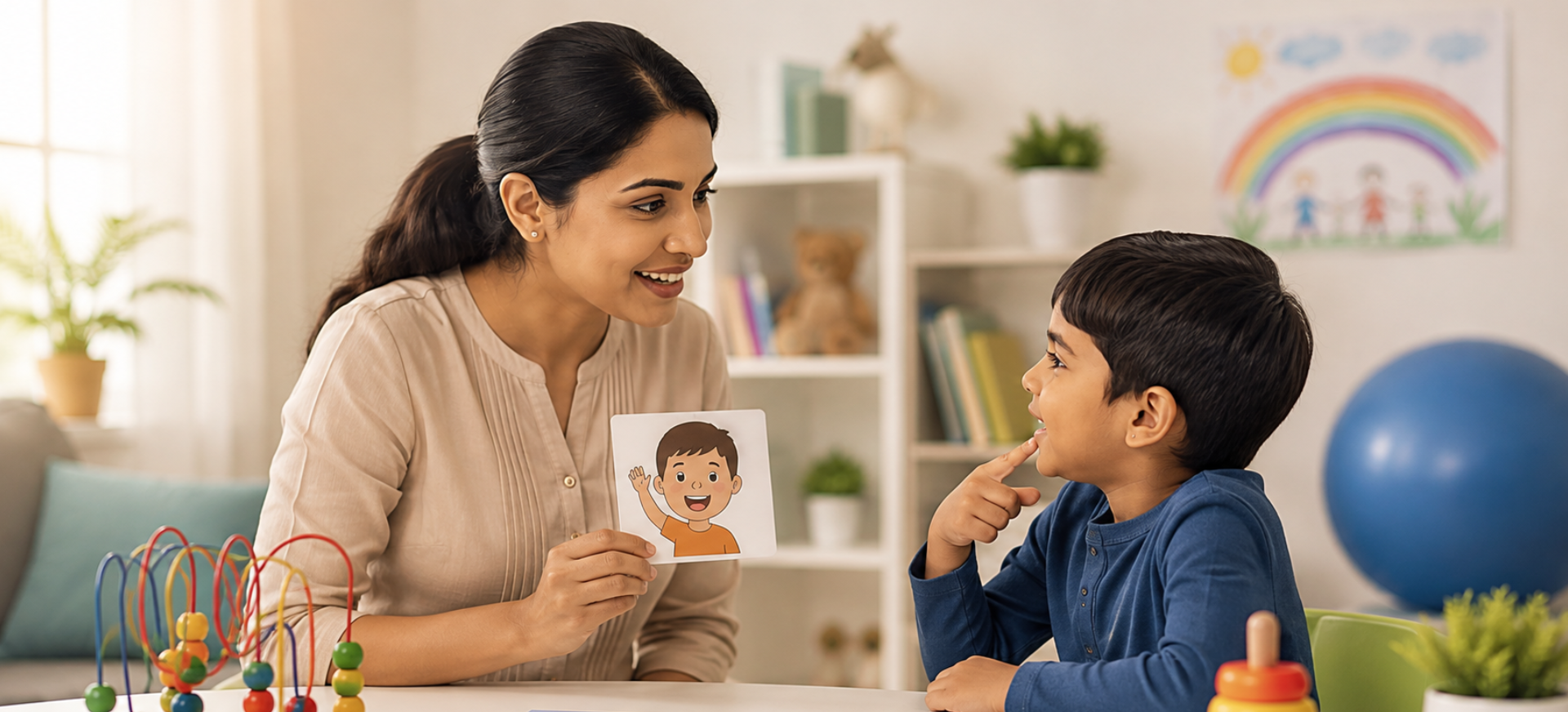
Speech therapy for autism is an evidence-based intervention by trained Speech-language pathologists (SLPs) to help children in spectrum resolve difficulties associated with communication. It is a personalised approach to improving communication skills to meet each child's unique needs.The focus is usually on three main areas, which includes speech, language, and communication. While some autistic children may be non verbal, and some being verbal also struggles to communicate as they will have difficulty with formation of grammatical sentences appropriately. Depending on the child's abilities and severity, speech therapy includes improving spoken language (increasing the utterances in the sentences), nonverbal communication, and social interaction.
Speech and Language Development Challenges in Autism
Speech therapy techniques for autism aim to work on communication challenges, which can vary widely from one child to another. Some of the common speech and language challenges include:
- Delayed Speech: Some autistic children develop speech later than their peers (also referred to as delayed speech development), while others remain minimally verbal or complete non-verbal.
- Limited Vocabulary: Learning and using new words can be a challenge. Some children only use familiar words repeatedly as they may have limited words in their vocabulary and find it difficult to expand their vocabulary and express their ideas.
- Difficulty with Social Cues: Understanding facial expressions, tone of voice, body language, or knowing when to start and end a conversation may be a challenge.
- Echolalia: Under this condition, children with ASD repeat words or phrases that they hear or have heard earlier, as echolalia can be immediate or delayed. Echolalia, although is a challenge due to repetition, which can also be modelled into meaningful communication development.
- Limited Use of Gestures: Maintaining eye contact, nodding, pointing, waving, and other forms of non-verbal communication and use of facial expressions to communicate are often less frequent in children with autism.
- Difficulty with Conversation Flow: A natural progression of conversation may not always be possible. Autistic children often struggle with taking turns, staying on topic, and responding appropriately.
- Challenges with Language Comprehension: Besides conversing, responding when conversed to through answers, understanding figurative language, implied meanings, and following instructions is another communication challenge resulting from autism.
Speech Therapy Techniques For Autism
Speech and language development in autistic children involves using a combination of techniques targeting their specific challenges. The American Speech-Language-Hearing Association and other recognised autistic associations recognise the following techniques for speech therapy:
-
Augmentative and Alternative Communication (AAC)
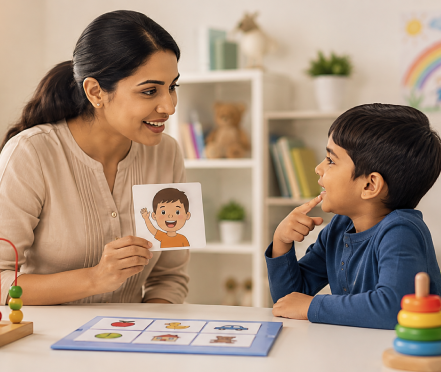
AAC includes communication boards, picture symbols, sign language, and other visual techniques which make speech therapy engaging. AAC is either unaided or aided. Unaided AAC involves no equipment. SLPs generally use pointing, gesturing, facial expressions in this form of AAC. Aided AAC, on the other hand, involves the use of tools like picture boards, communication books, speech-generative devices, interactive apps, etc.
-
Picture Exchange Communication System (PECS)
PECS is a type of Augmented and Alternative Communication technique where autistic children progress through six phases. Skills are built through these phases in a logical progression:
1. Picture Exchange: The child learns to hand over a picture of a desired item to communicate a need or request.
2. Encouraging Communication: Independently approaching a communication partner is encouraged by increasing the distance between pictures and the child and trying different settings.
3. Teaching Discrimination: The child learns to choose the correct picture from multiple options to accurately communicate what they want.
4. Building Sentence Structure: The child begins combining sentence strips with phrases like "I want" with pictures to form simple sentences.
5. Response to Questions: In this phase, the child is prompted with simple questions like "What do you want?" by selecting and arranging appropriate pictures.
6. Encouraging Comments: The learning comes full circle with the child progressing beyond making requests to commenting on their feelings, environment, objects, and events, through sentence strips.
- Play-Based Speech Therapy
For most children, Speech Language pathologists will recommend play based therapy as a natural way to encourage communication. Use of toys, games, role-play, and shared activities helps children develop language, take turns, express ideas, and interact with others in meaningful ways. Many speech therapy activities for autism are built around play with cause-and-effect toys, sensory play, music and movement, pretend play, etc.
-
Naturalistic Language Intervention
Unlike the structured speech therapy techniques for autism, this approach builds communication through a child's everyday routines and interests. It is naturally embedded during activities like playing, reading, and mealtimes where the child takes the lead. An SLP would encourage requests, responses, turn-taking, and language use in these familiar settings to make it easier to apply communication skills in daily life.
-
Social Communication and Pragmatic Therapy
This type of speech therapy for autism helps children understand the social side of communication that others may perceive naturally, while people on the spectrum may need to learn. It targets skills such as starting and ending conversations, taking turns while speaking, maintaining eye contact where appropriate, understanding facial expressions, body language, understanding emotions, tone of voice, and adapting communication to different social situations. These skills are taught through social stories and conversation pacing practices.
-
Applied Behavioural Analysis (ABA)
ABA therapy is a well-researched autism intervention that supports behaviour management and effective communication. It is often used alongside speech-language therapy for autism to reinforce positive communication behaviours and address tendencies that interfere with effective communication.
Some of the techniques that are part of ABA are:
1. Discrete Trial Training (DTT): Breaks down communication skills training into smaller, manageable steps.
2. Natural Environment Training (NET): Real-world situations are incorporated for functional teaching.
3. Functional Communication Training (FCT): Focuses on encouraging expression of desires and needs and replacing challenging behaviours with more constructive communication methods.
4. Reinforcement and Prompting: A reward system is used to encourage involvement and motivate children to continue applying the correct communication methods.
5. Speech Generalisation and Maintenance: Contextual usage of communication is emphasised at home, school, and during social play with other children.
Role of Early Intervention
While every autistic child develops at their own pace, recognising communication differences and delay in communication at an early age creates an opportunity to get support when developmental skills are rapidly progressing that is during the critical period of the brain development. During critical period, child’s brain is more flexible and open to learning. The first few years of life are the most crucial for laying down neural pathways for language and communication.
Early intervention does not mean achieving immediate results. Instead, it aims to gradually build speech and language skills and helps to build the gap between the chronological age (actual age of the child) and the functional age (speech age post assessment). Progress is subjective to each child's individual strengths, needs, consistency, severity, motivation and parents efforts and willingness to stimulate the child at home and use the techniques at home that are used in the therapy sessions.
Early intervention also helps in:
- Accessing appropriate services for speech therapy in managing autism.
- Building natural engagement with the child and improving family involvement
- Establishing a clear routine that is easily followed at home.
- Expanding vocabulary in the developmental years
- Familiarising with social skills through play and increased interaction
- Developing confidence and improving emotional regulation
- Teaching through imitation of sounds, gestures, and actions, which work especially well for young children
Impact of Speech Therapy on Children With Autism
The benefits of speech therapy for autism extend beyond helping children speak clearly. It builds the foundation for self-expression, connection, understanding, and independent functioning as children navigate ASD symptoms. Over time, children undergoing speech therapy for autism experience:
- Reduced Frustration While Interacting: As children find reliable ways to express their needs and feelings, they are less overwhelmed in everyday interactions.
- Stronger Social Connections: Most parents report that speech therapy for autism has helped their children engage more comfortably within the family and with siblings, teachers, peers, pets, etc.
- Improved Functional Communication: With improved communication, autistic children are better equipped to ask for help, make choices, share ideas, and manage daily activities independently.
- Increased Confidence: Better speech and language skills also contribute to a positive attitude when it comes to initiating conversation and seeking understanding from others.
- Greater Participation in Learning: Through better understanding and communication, autistic children do better with classroom routines and age-appropriate learning activities.
- Increased Self-Advocacy: Speech therapy for autism also helps children set boundaries, ask for help, and express discomfort.
What to Expect in a Speech Therapy Session for Autism?
Speech therapy sessions for autism follow a structured path that focuses on gradual improvement. The journey with a speech-language pathologist progresses as follows:
Choosing a Speech Language Pathologist for Autism
The right SLP can make a world of difference in how speech therapy helps your autistic child. Here's how you can shortlist them:
- Check whether the SLP is RCI licensed from a recognised university and has experience working with Autism children.
- Enquire about the speech therapy techniques used and how they help the distinct needs of children on the spectrum.
- Consider therapists that focus on individualised support with parent involvement.
- Look into a multi-disciplinary setup where speech therapists coordinate with other team members who handle paediatrics like a psychiatrist, paediatrician, neurologists, etc.
- Pick a nearby clinic to reduce travel sensory overload or an SLP specialising in interactive online sessions.
Parent Involvement and At-Home Support
Most SLPs seek parent involvement to enhance learning. At-home support is a crucial part of speech therapy. Here are some of the ways parents and caregivers can incorporate speech therapy for autism at home:
- Encourage practice during playtime, reading, outings, meals, etc.
- Celebrate little progress through acknowledgement and rewards
- Keep communication natural and adapt to the developmental progress of an autistic child
- Model the speech therapy activities without overcorrecting or restricting
Helping Your Child Find Their Voice
The right therapist and timely support can make a world of difference in how autistic children express themselves and interact with others. A multidisciplinary psychiatric hospital for autism like Maarga Mindcare can be the right place to start. Our specialised team of therapists and autism doctors work together to provide personalised support that respects and accommodates your child's unique strengths and pace of learning. Get evidence-based care for your child. Connect with specialists at Maarga to discuss the next steps towards meaningful communication.
FAQs
What communication techniques work best for autism?
A single communication technique cannot be categorised as best. Speech-language pathologists combine techniques like AAC, PECS, play-based therapy, and naturalistic language intervention, and social communication training based on your child's needs.
At what age should speech therapy start for autistic children?
Speech therapy is best received in the first five years of development, but early intervention at any stage also helps.
Is PECS or AAC better for autism?
PECS is a type of AAC. Thus, one is not necessarily better than the other. SLPs use a combination of different techniques for optimal results.
How long does speech therapy for autism take?
There is no fixed timeline. Speech therapy sessions can continue for several months to multiple years based on the child's progress.
Can non-verbal autistic children benefit from speech therapy?
Speech therapy supports both verbal and non-verbal communication through personalised treatment plans.
How often should a child with autism receive speech therapy?
The frequency will be decided by the SLP based on the child's age, communication needs, progress, and therapy goals.
Can speech therapy improve social communication skills in autism?
Yes, social communication skills naturally develop as children with autism are trained to take turns in conversations, understand social cues, initiate interactions, and communicate more confidently.
Disclaimer:
The information provided on this page is for educational purposes only and does not replace professional medical consultation. Insomnia treatment results vary from person to person. Please consult a specialist psychiatrist or psychologist for personalised care. If you or your loved one is struggling with Insomnia, reach out to Maarga Mind Care – a trusted psychiatric hospital in India. Our experts can help you start your journey to recovery.
References
- India Autism Center. A comprehensive guide to speech and language therapy for autism.
- Prayatna. Speech therapy: How it helps children with autism (ASD).
- Stamurai. Speech therapy exercises for children with autism.
- Autism Speaks. Speech therapy.
- National Institute of Child Health and Human Development. Speech-language therapy for autism.
- Hopebridge. What is PECS? Hopebridge BCBA series.
- Speech and Language Kids. Autism resource page.
Techniques
- India Autism Center. Effective speech therapy techniques for autism.
- Hopebridge. What is PECS? Hopebridge BCBA series.
- BrightBridge ABA. ABA speech therapy techniques for autism: Effective methods.